A Mustachioed Menace
2025 Choose Clean Water Coalition Annual Report
Since it was introduced to Virginia’s rivers in the 1970s, the invasive blue catfish has flourished. With its prolific reproduction, large size, voracious appetite, few natural predators, and long lifespan, blue catfish are now an apex predator in the Bay. And its impact is severe.
The catfish boom is harming native species in our waters, especially on economically and ecologically valuable blue crab and striped bass populations. Given the widespread damage blue catfish are wreaking on the Bay’s ecosystem, the Bay community is actively looking for solutions.
In recent years, the Coalition has worked with the Bay’s Congressional delegation to alleviate inspection impediments which complicate the removal of these harmful invasive fish from the Bay and its tributaries. These efforts continue, as we also support state and federal efforts which would accelerate the removal, harvesting, and processing of invasive blue catfish from the Bay and its rivers and streams.
Other successful efforts include securing critical funding to address the invasive catfish issue in the Chesapeake. Over two successive Agriculture appropriation bills, $3 million was dedicated for catfish inspections and fish processing facility expansion. An additional $500,000 was also secured to support U.S. Department of Agriculture marketing and sales efforts to incentivize consumers to eat blue catfish.
Our push for increased investments to address the blue catfish threat continued with our annual Congressional appropriations requests. Included in our requests was funding for the U.S. Geological Survey’s Biological Threats Research Program to determine the extent of the catfish problem and identify opportunities to reduce and reverse the rapid expansion of this harmful invasive species.
“Invasive blue catfish represent an emerging risk to the economic vitality and treasured natural resources of the Chesapeake Bay. To address this threat, the U.S. Geological Survey is working in partnership with state and federal agencies, academic institutions, and the nonprofit community to develop a
coordinated science framework to better understand blue catfish diets, population growth, risks to public health, and potential mitigation strategies that inform management
efforts by state and local partners.”
One such opportunity already underway is getting more blue catfish on dinner plates throughout the Bay region for our furry companions. In July, the Coalition was excited to endorse the Mitigation Action & Watermen Support (MAWS) Act. Introduced by Congresswoman Sarah Elfreth (D-MD) and Congressman Rob Wittman (R-VA), this bipartisan legislation would establish a pilot program within the National Oceanic and Atmospheric Administration (NOAA) Chesapeake Bay Office to facilitate a new market for blue catfish in the pet and animal food industry. It would also instruct NOAA to collect data on the impact of this program on the biodiversity of the Bay and health of fish and crustacean populations.
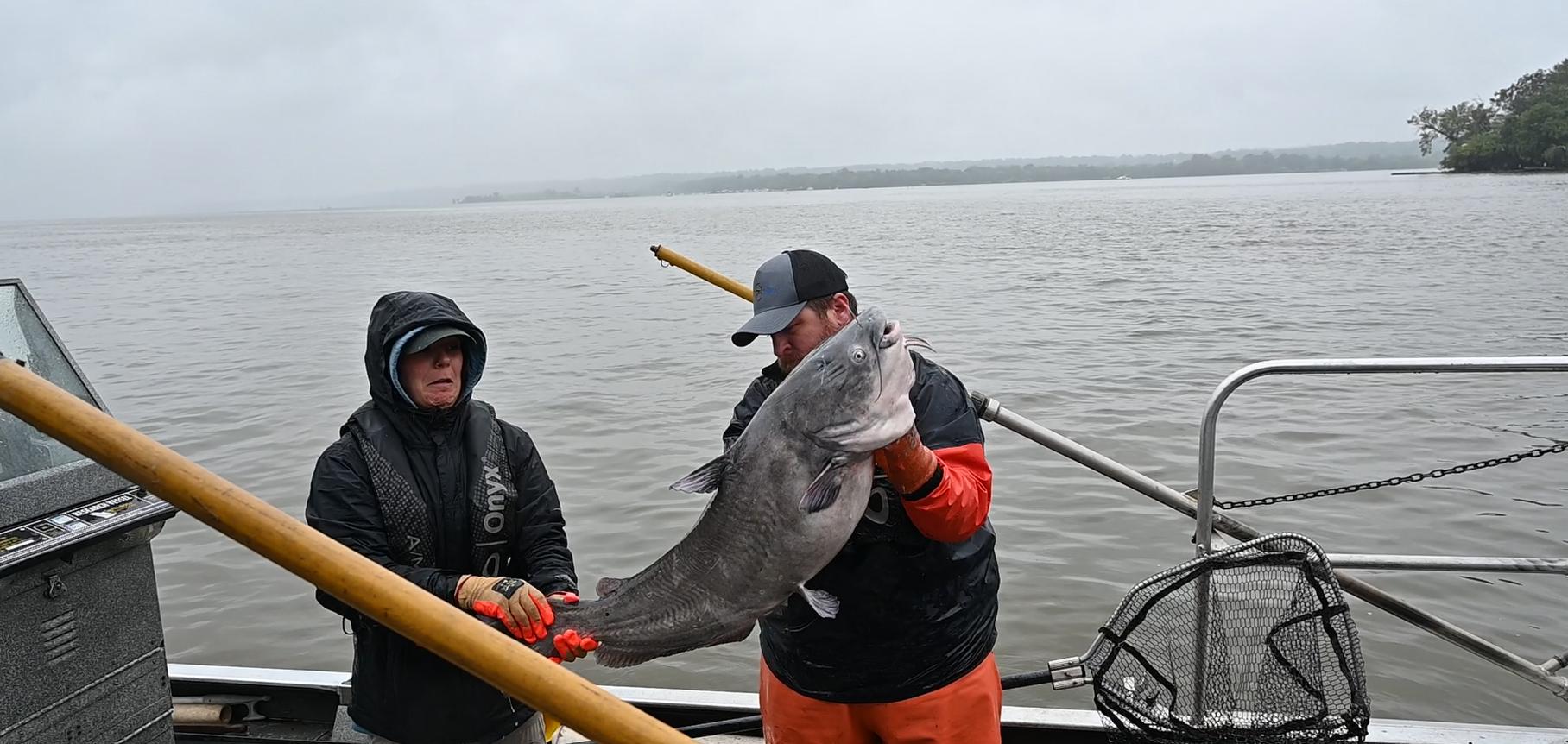
Often weighing in over 50 pounds, these mustachioed menaces comprise large portions of the total fishery throughout the Bay’s tributaries. In September, the Coalition’s Steering Committee participated in an electro-shocking demonstration on the Potomac River led by the Maryland Department of Natural Resources and U.S. Geological Survey. Attendees were astonished when the shocking, which only targets catfish, caused hundreds of catfish to float to the surface. While the catfish were not harmed by the shocking, the demonstration proved that we don’t always know what is lurking below the surface.
Invasive blue catfish will undoubtedly persist in the Chesapeake Bay region for the foreseeable future. But with collaboration, partnership, and innovative solutions, we can rein in the dramatic impact of this threat and protect native Bay species for generations to come.
Header photo: Staff from Maryland’s Department of Natural Resources wrangle a 35lb blue catfish following an electroshocking demonstration. Photo by Choose Clean Water Coalition.